Cash Flow Forecast for Small Business: Identify Shortfalls Early
Build a small-business cash flow forecast with dated receipts and payments, identify the lowest projected balance, and test delays before cash gaps occur.
A small business can have profitable work, outstanding invoices and insufficient cash to meet its next payroll. The problem is often timing: a customer payment arrives after a fixed obligation falls due. A cash flow forecast for small business translates expected receipts and payments into a dated running balance, making potential shortfalls visible while there is still time to respond.
Why Profitable Businesses Still Run Out of Cash
Consider a trades business that completes a $6,000 job and invoices on the 3rd of the month. After costs, the work appears profitable.
The customer, however, pays on day 40. In the first three weeks, $1,800 in rent, two wage runs and a $2,200 materials bill fall due. If opening cash cannot cover those commitments, the projected bank balance falls below zero on the 18th.
The figures are illustrative. The underlying distinction is not: earning revenue does not mean the related cash is available to pay current obligations.

Profit and available cash answer different questions
Under accrual accounting, revenue is recorded when earned, rather than when the customer pays. A cash forecast instead tracks when money is expected to enter and leave an account.
Three common sources of timing pressure are:
- Payment terms: Work is delivered before payment is due.
- Collection delays: Payment arrives later than expected.
- Fixed commitments: Rent, wages and repayments remain due regardless of collections.
Payment difficulties are widespread. Roughly four out of five small firms faced at least one payments-related challenge in the Federal Reserve's 2023 Small Business Credit Survey, as reported in its 2024 payments analysis.
A forecast serves a different purpose from a historical profit report. It estimates the available bank balance on specific future dates. That distinction applies to freelancers awaiting client payments, online sellers waiting for processor settlements, creators with irregular receipts and clubs collecting membership fees.
The operational question is: On which date will the available balance be lowest, and will it cover the obligations due then?
The Running Balance Method Explained
Opening balance + cash received - cash paid = closing balance.
Each period's closing balance becomes the next period's opening balance. This running calculation shows whether available cash remains sufficient as transactions occur.
Start with the monthly calculation
A basic model includes total cash inflow, total cash outflow, net cash flow, opening balance and closing balance. The FDIC's Money Smart cash-flow participant guide provides a foundation for organising receipts, payments and available cash.
Consider this hypothetical small retailer:
| Field | Worked example |
|---|---|
| Opening balance | $8,000 |
| Total cash inflow | $12,000 |
| Variable cash outflows | $5,000 |
| Fixed cash commitments | $9,000 |
| Total cash outflow | $14,000 |
| Net cash flow | -$2,000 |
| Closing balance | $6,000 |
The retailer ends the period with $6,000, despite paying out $2,000 more than it receives during that period. The opening balance covers the difference.
Closing cash is not profit. Borrowing and owner contributions can increase cash without creating sales revenue. Loan principal repayments and equipment purchases reduce cash when paid, even though their accounting treatment differs from an ordinary expense.
Apply the same calculation every day
A daily forecast uses the same arithmetic, assigning each receipt and payment to its expected bank date. When no transaction occurs, the balance carries forward unchanged.
For the retailer, customer receipts belong on expected clearing dates, supplier bills on scheduled payment dates and wages on pay dates. A monthly total alone cannot establish whether cash remains available throughout the month.
A positive month-end balance does not establish that the business could meet every earlier payment.
In Excel or Google Sheets, a simple starting model is a 30-row table with one row per day. Columns should include the date, opening balance, receipts, payments and closing balance. Notes beside material transactions make it easier to explain a projected dip.
Key Inputs and When Each One Hits Your Account
The controlling principle is cash availability. Record a receipt when funds are expected to be usable and a payment when funds are expected to leave the account. An invoice date, sale notification or tax filing date is not necessarily a cash movement.
Forecast inputs and the date each one moves cash
| Input | Cash moves when | Common mistake | How to model it |
|---|---|---|---|
| Customer invoices | Payment clears, based on expected terms and any likely delay | Recording the receipt on the invoice date | Use an expected clearing date and document any late-payment assumption |
| Card and processor sales | Funds become available after settlement | Treating the sale date as the bank date | Apply the processor's settlement lag without duplicating the receipt |
| Payroll | Wages are paid, with any related tax remittance recorded on its payment date | Counting withheld taxes twice or omitting the remittance | Record net pay and the tax remittance separately when those are the actual payments |
| Rent and loan repayments | Funds leave under the agreed payment schedule | Replacing known due dates with a monthly average | Use the scheduled debit dates |
| GST, VAT or BAS-related payments | The liability is paid | Treating filing and payment as the same event | Record the expected cash payment date and track reserves separately |
| Supplier bills | Payment is made under agreed supplier terms | Assuming an order date is a payment date | Use the agreed or scheduled payment date |
| Owner drawings and personal bills | Funds are drawn or debited | Mixing business and personal outflows without identifying them | Record actual transfer dates and distinguish the transactions |
| Insurance and annual subscriptions | The renewal payment is debited | Omitting infrequent commitments | Show the full renewal payment on its expected date |
| One-off purchases and repairs | The supplier is paid | Omitting known projects or possible unplanned spending | Enter confirmed purchases and identify contingency assumptions separately |
Settlement timing requires particular attention. The QuickBooks late-payments report describes ACH and card payments taking one to three business days to clear. The appropriate forecast date should follow the business's actual processor payout schedule, accounting for applicable fees or holds.
Separate a reserve from an actual payment
Setting money aside for an annual insurance bill is useful, but it does not convert the insurer's debit into monthly payments. The forecast should still display the full expected renewal payment. If reserve contributions are transfers between accounts included in the forecast, they must be handled consistently to avoid misstating total available cash.
Similarly, GST and VAT are taxes, while a BAS is an activity statement. Filing and payment may occur on different dates. The cash forecast should use the date funds are expected to leave.
Payroll also requires a consistent method. If net wages and withheld tax payments are entered separately, gross wages should not be added as a further outflow.
Check assumptions against the bank
Bank transactions provide an audit trail for forecast accuracy. Compare actual clearing dates and amounts with estimates, then update collection assumptions, processor settlement lags and recurring payment schedules where needed.
AI2Fin supports the record-keeping side of this process: bank feeds, statements and receipts can be brought in, and Fin categorises transactions, flags work-related and business deductions, shows a live refund or tax-owed estimate, and sends finished records to a ledger, spreadsheet or assistant. Those records can inform forecast inputs; expected future payment dates still require review.
Prioritise the transactions with the largest effect on the projected low point. An accurate estimate for a major receivable, payroll run or supplier bill is more consequential than detailed categorisation of minor spending when the purpose is to identify a cash gap.
Choosing Your Forecast Horizon
| Horizon | Granularity | Best for | Example |
|---|---|---|---|
| 30 days | Daily | Managing immediate payment obligations | Checking whether rent clears before a customer invoice |
| 60 days | Daily or weekly | Identifying a shortfall in the following month | Planning for a quarterly tax payment |
| 90 days | Daily or weekly | Preparing for larger or less frequent commitments | Testing whether a supplier deposit is affordable |
| 12 months | Monthly | Evaluating longer-term affordability | Assessing a $30,000 vehicle loan alongside operating costs |
The forecast horizon should match the decision. Short-term views support payment scheduling. Longer views help assess whether recurring commitments remain affordable.
Use detail where timing is tight
Daily detail shows the order in which receipts and payments occur. A weekly total may conceal a bill due early in the week if the corresponding customer payment arrives later.
Use exact dates when deciding whether a payment can be made now. Extend the forecast when future commitments could affect that decision.
For example, a hypothetical sole trader's 90-day daily forecast may identify its lowest balance immediately before an insurance renewal. A 12-month monthly forecast addresses a separate question: whether a $30,000 vehicle loan remains affordable after repayments, fuel, maintenance and seasonal changes in revenue.
The vehicle's purchase price is not the entire cash requirement. Include any deposit, ongoing operating costs and scheduled repayments, and record loan proceeds only once when they become available.
Keep operational and strategic planning separate
Formal business planning may require a substantially longer horizon. The U.S. Small Business Administration's financial-forecasting guidance recommends five years of financial projections for a business plan, with the first year presented in greater quarterly or monthly detail.
That strategic projection does not replace the dated payment schedule needed to manage an immediate shortfall. Equally, a healthy balance over the next few weeks does not establish that a new commitment will remain affordable during a seasonal decline.
- For payment decisions: Retain expected clearing dates and scheduled debits.
- For growth decisions: Document assumptions about revenue, staffing, borrowing and equipment.
- For continuity: Roll the forecast forward each week so the planning window does not shrink.
How to Build Your Forecast Step by Step
Start with the available bank balance, outstanding invoices, payroll schedule, supplier bills and other known commitments. The forecast need not be certain, but confirmed items should be distinguishable from estimates.
Build the dated transaction list
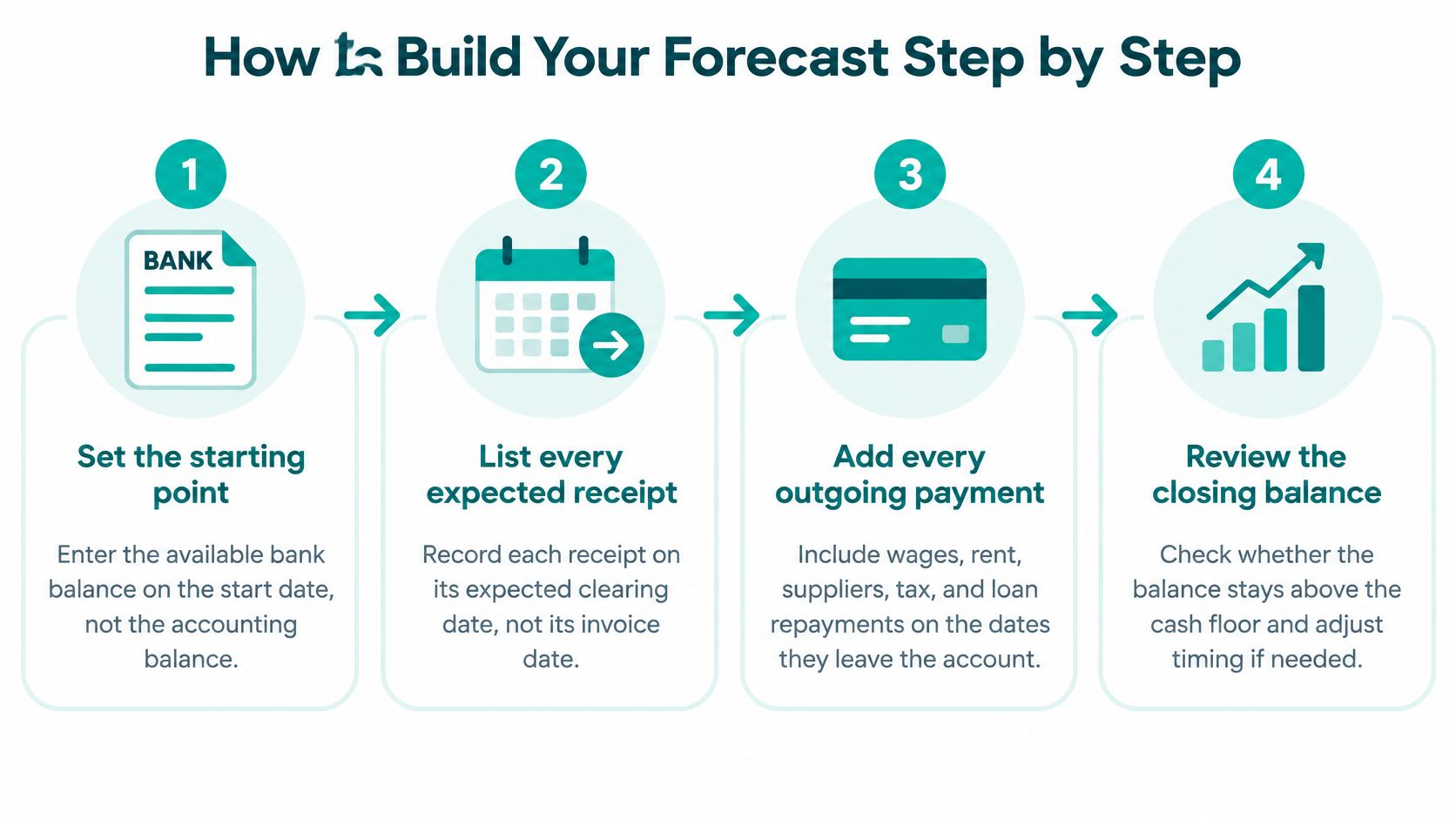
Establish the starting balance. Use the available bank balance on the forecast start date, not an accounting balance that includes unpaid invoices. Check pending debits and restricted funds before treating money as spendable.
List expected receipts. Assign customer payments to expected clearing dates. Note whether each date is based on contractual terms, a customer commitment or historical payment behaviour. Recording receipts on invoice dates can overstate near-term cash.
Schedule fixed payments. Include rent, loan repayments, payroll and subscriptions on their expected debit dates. Check contracts and payment schedules rather than assuming all recurring costs fall at month-end.
Add variable spending. Position materials around scheduled jobs, stock purchases around orders and routine supplies around expected buying patterns. Recent bank activity provides a baseline, which should be adjusted for known work ahead.
Calculate, challenge and maintain it
Identify a contingency allowance. Estimate potential unplanned spending and review the allowance against actual repairs or replacements. Label it clearly so it is not confused with a confirmed bill.
Calculate the running balance. Link each opening balance to the previous day's closing balance and extend the formula across the forecast. Resetting the balance each week would conceal the effect of earlier transactions.
Find the minimum balance. Highlight its value and date, then inspect the transactions immediately before it. Identify the specific receipt or payment assumptions responsible for the low point.
Reconcile weekly. Replace past estimates with settled amounts and investigate differences in both timing and value. When a payment is delayed, move the existing receipt entry rather than adding a duplicate.
Spreadsheet control: The first forecast balance should reconcile to available cash at the bank, and each later balance should flow from the preceding row.
Notes beside uncertain entries improve accountability. For example, a collection date described as "customer payment expected after approval" tells the reviewer what to confirm before relying on that receipt.
Reading Low Balances and Acting Before They Hit
The most useful output is often the lowest projected balance and the date it occurs, rather than the month-end figure. Compare that low point with the cash required to meet essential commitments.

Low-balance bands and the response each one calls for
A cash floor is a business-defined minimum available balance. It might be based on several weeks of essential payments, adjusted for the reliability of customer collections. The following bands are illustrative decision rules, not universal thresholds.
| Lowest projected balance | Interpretation | Potential response |
|---|---|---|
| Above the cash floor by at least two weeks of essential outflows | A relatively strong buffer | Continue monitoring and consider setting aside available surplus |
| Above the cash floor, with a large payment due within two weeks | Limited headroom | Confirm receipts due beforehand and review discretionary spending |
| Between zero and the cash floor | Reserve at risk | Accelerate collections, consider deferring non-essential spending and assess credit options in advance |
| Below zero on any day | Potential overdraft or missed payment | Agree revised terms, request a customer deposit or arrange a facility before the date |
| Below the cash floor only in a downside scenario | Reliance on timely receipts | Increase reserves, consider deposits on new work and review the forecast more frequently |
The floor should reflect payments that cannot readily be paused, including wages, premises costs, essential suppliers and unavoidable repayments. Unused borrowing capacity is not cash already in the bank.
Stress-test the receipts you're relying on
Collection delays should be modelled directly rather than hidden within a general reduction in sales. A 2024 UK government study of payment practices found that 49% of small businesses, compared with 36% of businesses overall, reported customers taking longer to pay than agreed terms.
Three illustrative scenarios are:
- Base case: Use contractual payment dates, adjusted for known customer behaviour and settlement schedules.
- Downside case: Move selected receipts 7 to 14 days later while leaving committed outflows unchanged.
- Severe case: Delay a major customer receipt by 30 to 90 days and assess whether essential payments remain covered.
These are stress-test assumptions, not predictions. When testing timing alone, leave the invoice amount unchanged to isolate the effect of a delayed receipt.
For each scenario, record the minimum balance, its date and the amount required to restore the cash floor. A month may end positive while an earlier daily balance shows insufficient cash for payroll.
The following video provides another overview of cash-flow planning.
Match the action to the cause
When a missing customer receipt creates the projected shortfall, confirm that the invoice was received, whether approval is complete and when payment is scheduled.
When a discretionary purchase creates the dip, review whether it can be postponed. If essential materials must be purchased before a customer pays, a deposit or staged customer payments may reduce the funding gap on future work.
Changes to supplier payment dates require agreement. Moving an entry in a forecast does not change the underlying obligation, and unagreed late payment can damage an important trading relationship.
Any credit facility should be assessed before the expected shortfall, allowing time for approval and access to funds. Borrowing can bridge a temporary timing gap, but it does not resolve a pattern in which cash outflows persistently exceed collections.
A weekly review helps distinguish an isolated low point from a recurring problem. Repeated breaches may require changes to collection practices, customer terms, owner drawings or operating costs.
Open Your 90-Day Forecast This Week
A practical first step is to identify the next major payment, then list the bills, paydays and expected receipts around it. Extend the schedule across 90 days using bank records, contracts and invoices. Starting with the current available balance, calculate the running daily balance and locate its minimum.
Make one decision from the result
- Check the floor: Compare the minimum projected balance with a chosen reserve, such as two weeks of essential outflows.
- Challenge a significant receipt: Delay the largest expected invoice by 14 days as a hypothetical test, leaving outgoing commitments in place.
- Determine the response: If the delayed receipt pushes the balance below the floor, follow up on the invoice, seek a deposit on future work or agree a revised supplier schedule before the shortfall.
Moving a supplier payment earlier is useful only where the agreed arrangement improves the overall position, such as through staged payments. Moving it later requires the supplier's agreement, not merely a change to the spreadsheet.
AI2Fin's Cash Flow Forecast, available through AI2Fin's tools, provides 30-, 60- or 90-day forecasts on ELITE+ and AUTO+ plans, not Free or Premium. It can be used alongside documented bills, pay and invoice assumptions to review the projected balance and test the effect of delayed receipts. Forecast outputs remain dependent on the accuracy of the underlying dates and amounts.
The forecast does not need to predict every transaction precisely to support a useful decision. It needs credible dates, transparent assumptions and enough lead time to address commitments before cash runs short.
The central test is whether the lowest projected balance can cover the payments due on that date.
AI2Fin brings transaction records and cash-flow planning into one workflow. Its transaction categorisation and export capabilities support the preparation of reliable records, while eligible plans provide short-term cash flow forecasts. Visit AI2Fin to review the available tools and plans.