What Is Cash Receipts and How Businesses Record Them
What is cash receipts? Money that actually arrived, including cards and transfers, recorded on the date received and reconciled to the bank.
Cash receipts are money received in a period, including cards and transfers, dated when the funds arrive rather than when the invoice was issued.
You might be closing the till, checking a payment app, or sorting a club's bank statement with a pile of invoices beside you. The awkward part isn't adding everything up. It's deciding what belongs in the receipts total, what counts as sales, and what still hasn't been paid.
What Cash Receipts Actually Are
It's Friday afternoon. Your till contains notes and coins, the card reader shows completed payments, and a customer's late bank transfer has finally arrived. All represent money collected, even though only some of it is physical cash.
A cash receipt is an amount received during a defined period, regardless of when you earned it. Washington State's budget glossary uses that definition; for example, an invoice issued on June 28 and paid on July 3 produces a July receipt, not a June receipt.
The everyday word “cash” can make this confusing. In bookkeeping, the collection method doesn't have to involve banknotes.
Look beyond the till
Your receipts can arrive through several routes:
- Physical payments: Notes, coins, checks, and money orders.
- Card collections: Credit- and debit-card payments collected through your payment provider.
- Electronic payments: Bank transfers, ACH payments, wires, and other electronic transfers.
A musician paid by transfer after a performance has collected money just as surely as a stallholder taking notes. A club treasurer shouldn't leave card-reader takings out of the records because nobody handed over cash.
There's another useful distinction. “Cash receipts” can mean the money received, while “a receipt” can mean the document acknowledging a payment. You need records of the first, supported by evidence such as the second.
Separate collection from its purpose
A bank notification confirms that money arrived. It doesn't tell you whether that money came from a customer, a lender, an owner, or someone refunding an earlier purchase.
Practical rule: Identify both the payment and the reason for it before you call it sales.
For each receipt, capture the date, amount, payer, payment method, purpose, and transaction or deposit reference. Those details let someone else follow the payment without relying on your memory.
If you're searching “what is cash receipts” because your invoice list and bank balance don't agree, you're comparing different things. The invoice list records requests for payment. The receipts record shows collections, including payments connected with work invoiced earlier.
Why the Receipt Date Changes the Books
Money in the account is not the same number as profit.
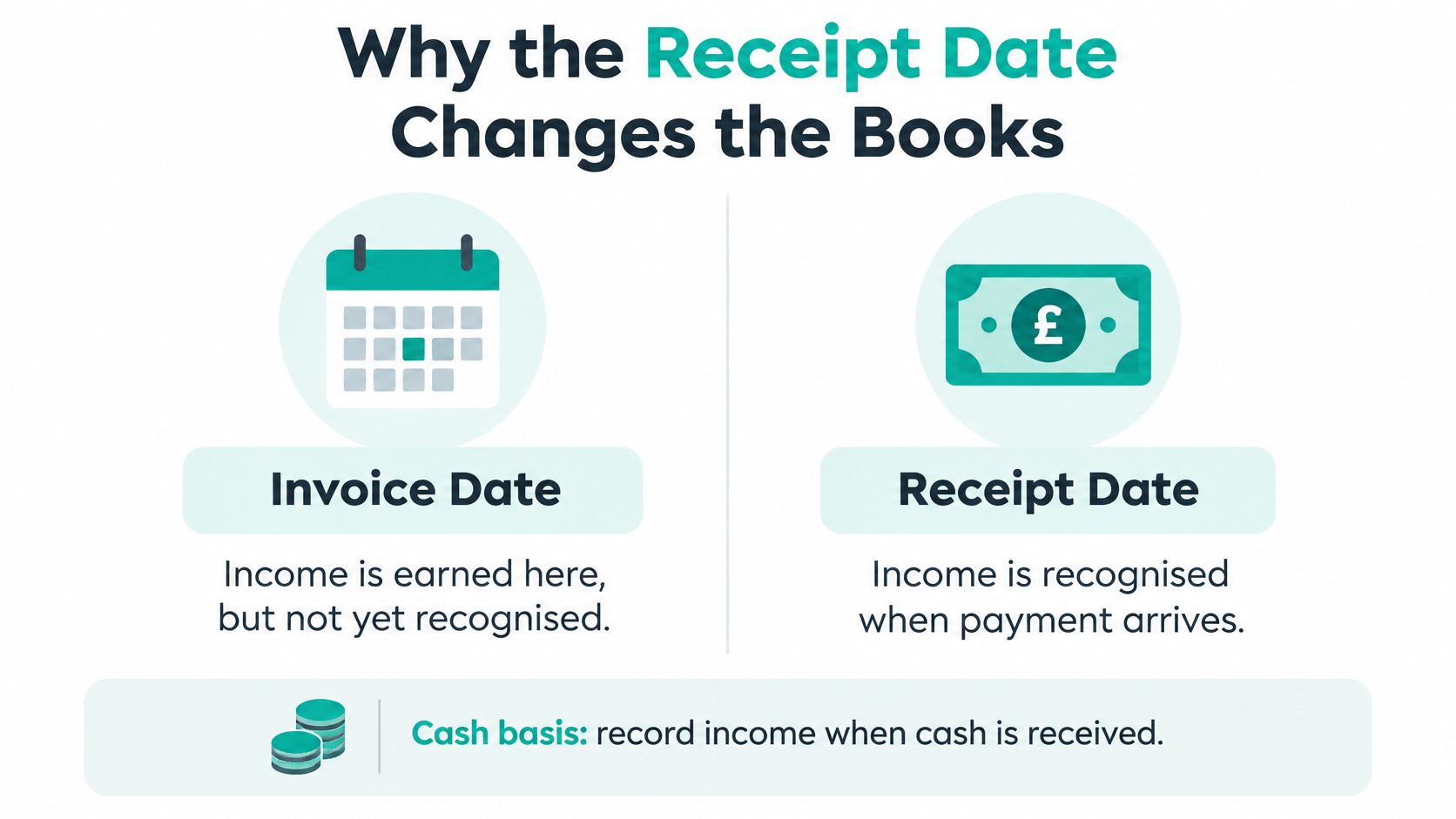
Cash-basis accounting generally recognises business income when payment is received and expenses when payment is made. Accrual accounting follows when revenue is earned and expenses are incurred, even when the bank movement happens later.
The Congressional Research Service's explanation of accounting methods describes this distinction: a contractor completing a $12,000 project in December but collecting payment in January would generally record a January receipt under the cash basis, while accrual accounting recognises December revenue.
Neither method changes the customer's payment. They change which reporting period contains the income.
Compare the same events
Cash receipts versus accrual for the same event
| Event | Cash-receipts view | Accrual view |
|---|---|---|
| Unpaid customer invoice | Not a cash receipt until paid | Revenue if already earned |
| $12,000 job done in December, paid in January | January receipt | December revenue |
| Card sale later settled to the bank | Receipt when funds are collected | Often revenue at the sale |
| Customer refund paid out | Cash leaves; not new income | Reduces revenue or is an expense |
| Loan drawdown or owner money in | Financing inflow, not sales | Liability or equity, not revenue |
The contractor example illustrates timing, not an automatic rule for every tax return. Your jurisdiction, business circumstances, and applicable accounting requirements determine which method you can use.
A customer refund deserves its own entry too. Don't delete the original collection just to make the records look tidy. Keep the incoming payment and outgoing refund traceable, then apply the appropriate accounting and tax treatment.
The timing distinction is easier to follow visually.
Use receipts to judge available money
Receipts help answer a practical question: what have customers and other payers delivered? That's useful when deciding whether you can pay a supplier or commit to an event.
They don't answer every financial question. A busy collection period might include overdue bills from earlier work, while a quiet collection period might follow a productive stretch of unpaid projects.
Keep an unpaid-invoice list alongside your receipts journal. Keep upcoming bills separately as well. Otherwise, you might mistake a healthy bank balance for spare money when suppliers, taxes, or event costs still need paying.
Where Cash Receipts Usually Come From
A loan lands in the account during a slow trading period. If you code the deposit as sales, your report suddenly suggests customers have been buying enthusiastically.
They haven't. You've borrowed money.
The cash-flow reporting guide published by Practising Law Institute separates receipts by the activity generating them: operating collections, investing receipts, and financing inflows. That distinction keeps customer demand separate from asset disposals and external funding.
Give each inflow a useful class
Operating receipts usually come from running the business or organisation. Customer payments belong here, along with fees, commissions, and other ordinary operating collections.
Investing receipts arise when you sell long-lived assets or investments. Selling a work van brings money in, but it doesn't show that your regular services are selling better.
Financing receipts come from borrowing or owner and shareholder funding. They can help you pay bills, but they don't establish that day-to-day operations support themselves.
Common cash receipt sources and how to class them
| Source | Class | Supporting evidence | Counts as sales |
|---|---|---|---|
| Customer cash, card or transfer for goods or services | Operating | Till tape, invoice and processor report | Yes |
| Tips, fees and commissions received | Operating | Receipt book or payout report | Yes, as business income |
| Interest or dividends received | Operating | Bank or broker advice | No |
| Sale of equipment, vehicle or investment | Investing | Disposal invoice and asset record | No |
| Loan drawdown | Financing | Loan agreement and statement | No |
| Owner or shareholder contribution | Financing | Capital or equity record | No |
Interest and dividend classification can differ under the reporting framework you use. The operating treatment shown here follows the cited guide, rather than setting a universal rule.
Check the document before choosing the category
For customer collections, match the payer to an invoice, till report, or processor record. For borrowing, use the lender's statement and agreement. For an equipment sale, retain the disposal invoice and update the asset record.
A club grant or donation needs a different check. Read the award letter or donor instructions, identify any spending restrictions, and use a separate category rather than forcing it into customer sales.
Restricted funding may sit in the same bank account as unrestricted money. Your records still need to show what the organisation is permitted to spend it on.
- Use clear source codes: Customer collections, asset disposals, loans, and capital contributions should remain distinguishable.
- Resolve unknown deposits: Hold an unexplained receipt in a review category while you identify it.
- Preserve the paperwork: A bank description alone may not explain the legal or accounting nature of an inflow.
This classification also improves a cash-flow forecast for a small business. You can plan around expected customer collections without assuming another asset sale or loan will be available whenever the balance gets low.
How to Record Each Cash Receipt
Use the same recording routine whether the payer is a concert organiser, a retail customer, or a club member. A spreadsheet works well if the entries are consistent and the supporting files are easy to find.
The IRS guide to business records expects records to show both the amount and source of gross receipts; a retailer collecting $800 in cash and $1,200 through cards during a week needs evidence supporting the $2,000 total and how it was received.
Capture the fields that prevent mistakes
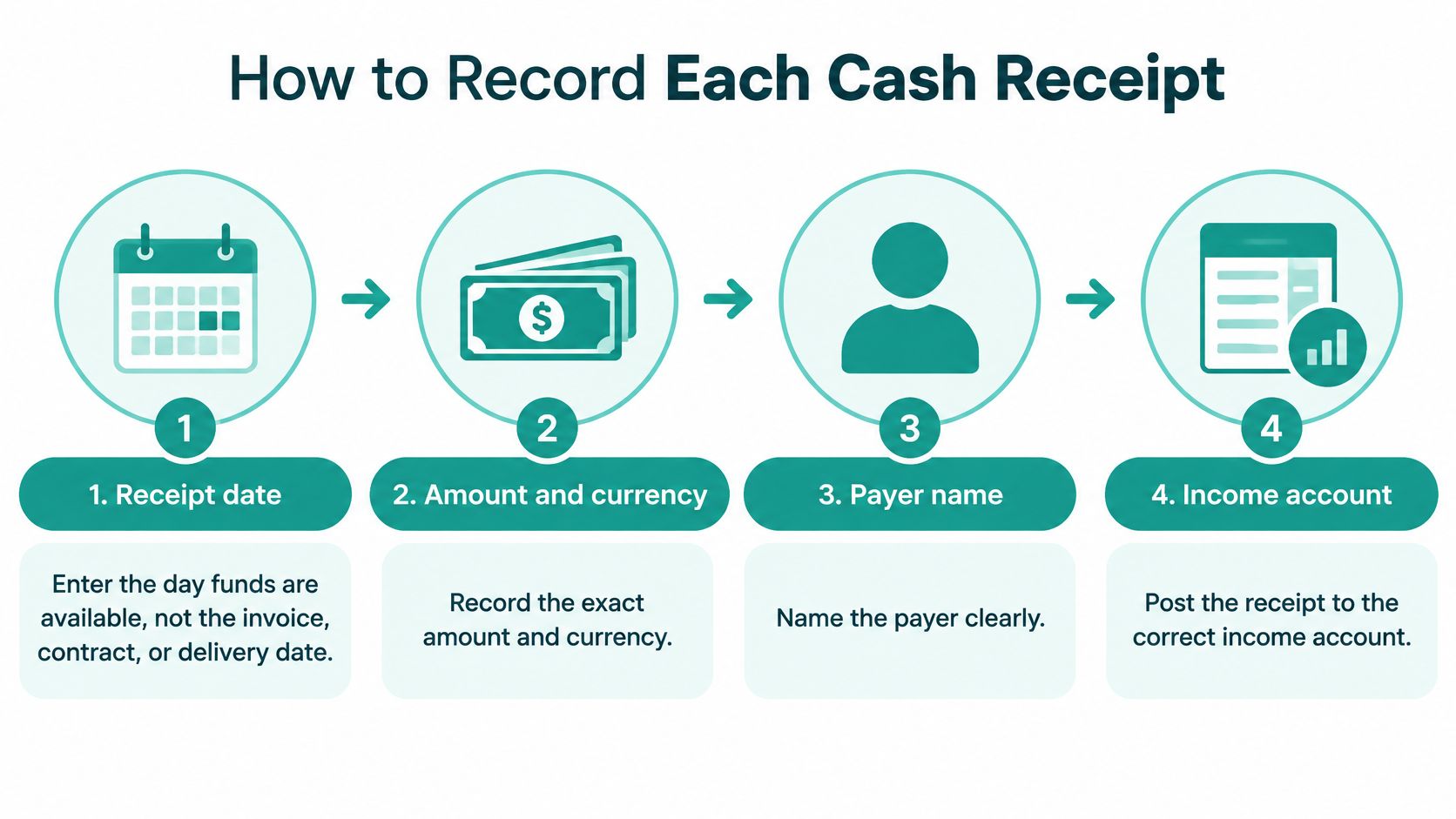
Enter the receipt date. Use the date the payment was received or became available under the applicable rules. Don't automatically copy the invoice, contract, or delivery date.
Record the amount and currency. Preserve the original currency where relevant. This prevents a foreign-currency payment from being mistaken for the same amount in your home currency.
Name the payer. Use a recognisable customer, member, lender, or owner name. Keep the bank's original reference as supporting detail.
Identify the payment method. Record cash, cheque, card, transfer, or payment in kind. This helps explain why the receipt may not appear as an individual bank deposit.
Connect the payment to its purpose. Add the invoice, project, membership, event, or other reference. Mark partial payments so you don't accidentally close an invoice that remains unpaid.
Choose the source and tax treatment. Code operating, investing, or financing, then record GST, VAT, or sales tax separately where applicable. Don't let the payment method determine the category.
Attach supporting evidence. Keep the till tape, receipt-book entry, invoice, deposit slip, card record, or statement. An invoice helps identify the transaction, but doesn't by itself prove payment.
Save a matching reference. Include the deposit or processor payout reference. For non-cash consideration, retain the agreement and valuation evidence instead of inventing a bank match.
The visual below highlights the initial capture fields. Choose the correct ledger account after identifying the receipt's source.
Keep financing out of the sales column
Sample cash receipts journal lines
| Date | Payer | Method | Source class | Amount | Support |
|---|---|---|---|---|---|
| 5 Apr | Client (invoice 20 Mar) | Transfer | Operating | £1,000 | Invoice and bank transaction reference |
| Week 1 | Retail till | Cash $800; cards $1,200 | Operating | $2,000 | Till tape and processor report |
| Date funds received | Lender | Loan drawdown | Financing | Amount advanced per statement | Loan agreement |
| Date funds received | Owner | Capital injection | Financing | Amount contributed per capital record | Capital record |
Keep a source-code column even if your spreadsheet has a separate sales column. That gives you a way to total all incoming money without treating all of it as trading income.
For grouped collections, keep a summary line supported by the detailed report. You don't need to retype every card transaction if the attached processor report supplies a clear audit trail.
Cash Receipt Examples You Can Copy
The most useful examples are the ones where the invoice, bank deposit, and actual receipt don't line up neatly. Late payments, cheques awaiting deposit, and barter all need a little care.
Keep the payment evidence with the invoice so the timing remains clear.
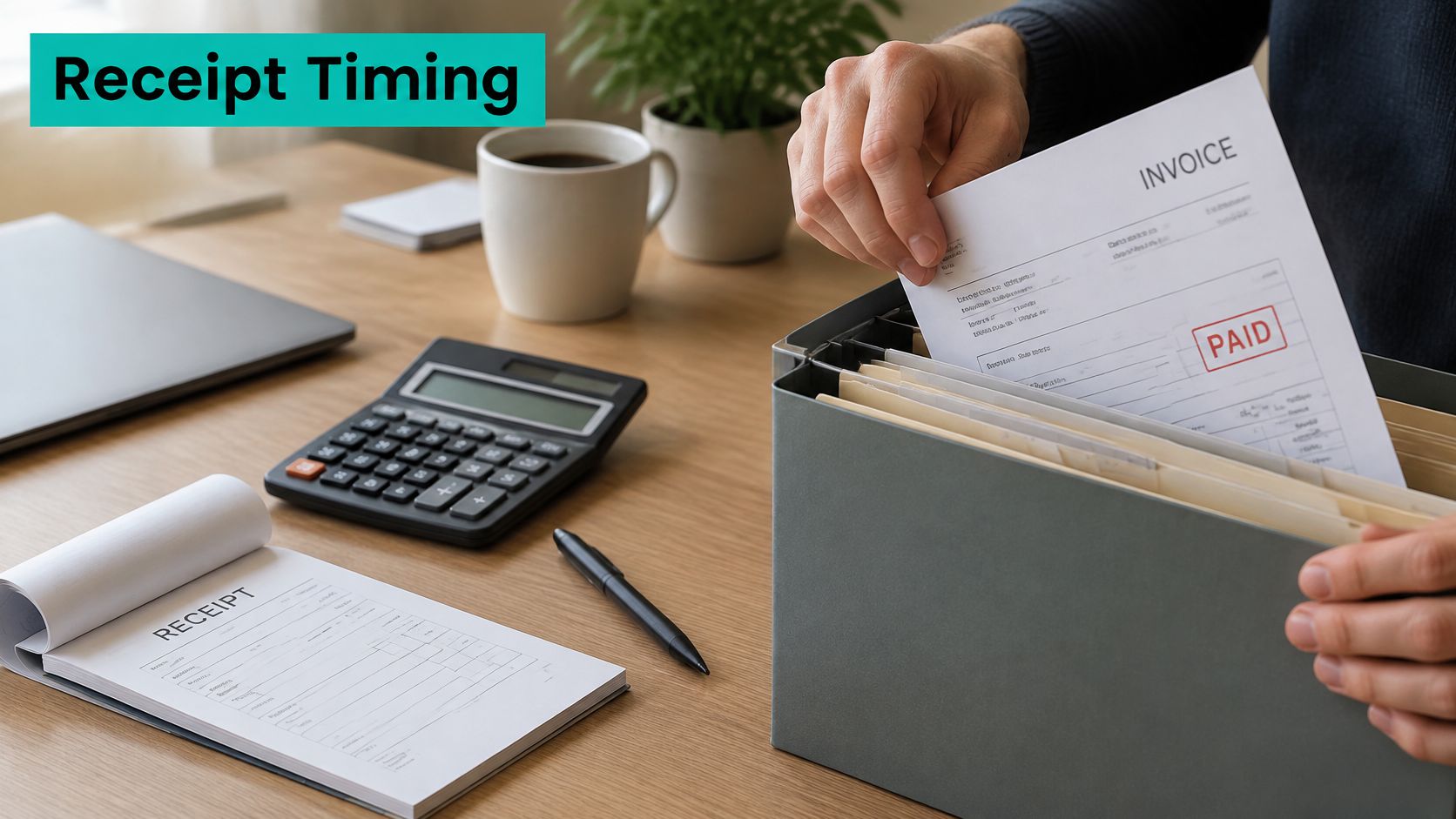
A late-paying freelance client
Say a UK sole trader invoices £1,000 on 20 March and receives payment on 5 April: under the UK government's cash-basis guidance, the receipt belongs to the tax period containing 5 April.
Keep the invoice date in the invoice record and the collection date in the receipts journal. Don't move the receipt backwards because the work happened earlier.
Use a consistent timing method that follows the applicable rules. In particular, cheque timing needs a deliberate policy rather than whichever date produces the preferred result on a return.
A cheque received before year-end
A US freelancer receives a valid cheque before the tax year ends but deposits it afterwards. Under the constructive-receipt principle explained in IRS Publication 583, funds available without substantial restriction can count as received even before they appear in the bank.
The amount to record is the cheque's business-income amount, using the receipt date required by those rules. Retain evidence of when it arrived and show the later deposit as the banking of that receipt, not another sale.
This is why delaying a deposit doesn't necessarily delay taxable income. An unpaid invoice and an available payment aren't equivalent.
For a video explanation to accompany these examples, use the player below.
A camera instead of a cash payment
A photographer accepts a £300 camera instead of £300 cash for work: HMRC's business income guidance includes payment in kind in cash-basis receipts, so the photographer may need to record £300 of business income at fair market value.
Record the exchange when received under the applicable rules, describe the camera, and retain support for its value. Consider its treatment as an acquired business asset separately.
No bank deposit doesn't automatically mean no business receipt.
The same capture discipline helps a club running a cake stall. Log the notes and card collections, then identify how each was banked or settled. Don't record the bank deposit as another round of takings.
Special receipts when a trade ends, including amounts relating to trading stock or work in progress, also deserve a separate policy check. They shouldn't disappear just because they don't resemble an ordinary customer payment.
How to Reconcile Receipts to the Bank
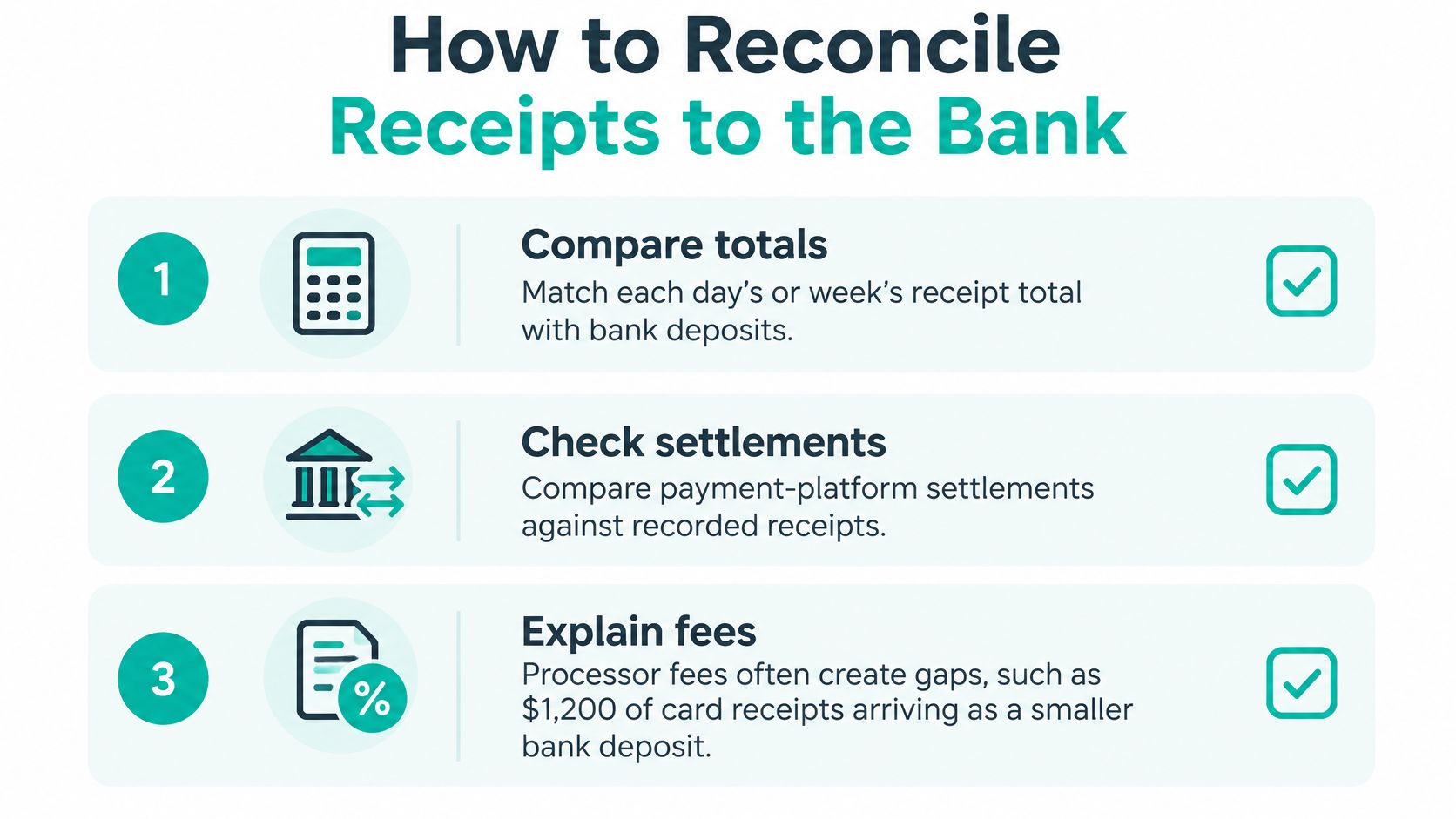
Your card report shows more collected than the bank deposit. Before changing the sales total, check whether the processor deducted fees.
For a hypothetical payout, $1,200 of card receipts might arrive as $1,164 after deductions. Keep the gross collection in the receipt record and account for the supported processing fee separately, rather than shrinking the sale to fit the bank.
Match the movement, then explain the gap
Reconciliation means demonstrating how your receipt records connect to cash held, processor balances, and bank activity. A mismatch is a question to investigate, not a reason to overwrite the original entry.
Use this closing checklist:
- Compare recorded collections: Match till summaries, receipt-book entries, and customer payments to the journal.
- Inspect processor payouts: Identify which collections each settlement contains, along with fees, refunds, or other adjustments.
- Unpack mixed deposits: Separate cash takings from loan proceeds or other money included in the same deposit.
- Exclude internal transfers: Moving money between your own accounts doesn't create business income.
- Track unbanked receipts: Keep cash and cheques awaiting deposit identifiable until they clear.
- Investigate differences: Look for missing entries, duplicate imports, reversed payments, and settlement cutoffs.
A cash deposit can represent several collection days. A processor payout can combine many customers. Use a deposit schedule or payout report to connect those grouped amounts without duplicating income.
The matching routine can stay simple.
Keep evidence that explains the transaction
The Australian Taxation Office's record-keeping guidance says business records must explain transactions, be in English or readily translatable, and generally be retained for five years.
Income evidence can include tax invoices, receipt books, cash-register tapes, and records of cash and digital sales. Retention requirements differ by jurisdiction, so use the rules governing your organisation rather than adopting another country's period automatically.
Apply the same evidence standard to payments out. A small cash purchase needs its date, supplier, business purpose, amount, and supporting receipt, just as an incoming collection needs an identifiable source.
Finish the reconciliation with an explained difference schedule, not a forced match. Money still held in the till or awaiting processor settlement can be legitimate, provided the records show where it is.
Sort This Week's Receipts Before They Blur
A club treasurer reviewing the week's money might see cash from a stall, a member's transfer, and a loan in the same bank records. Sort each inflow while the payer and purpose are still clear. The stall and member payment are operating receipts; the loan is financing, not sales.
Gather the bank activity, till and processor reports, and any records of cash held. Keep unpaid invoices on a separate list: an invoice is not a receipt until payment arrives.
Give the week a clear ending
For example, a cake stall takes £180 in notes and card payments, a member transfers £60 for a tournament, and a relative lends the club £500. Record the stall and tournament collections as operating receipts, and the loan separately as financing. A sale of an asset also belongs outside operating collections.
Keep the stall summary, payment reference and loan agreement with the records. Reconcile processor deductions against the payout, and identify any notes still held rather than deposited.
Before you close: Give every inflow a purpose, a category and evidence another treasurer can follow.
Use a short review list:
- Confirm the payer: Replace unclear bank references with a recognisable name or description.
- Check the classification: Separate loans, transfers and asset-sale proceeds from operating collections.
- Keep the evidence: File the invoice, collection report, agreement or deposit record that explains the money.
- Resolve the match: Record fees and deposits still in transit; do not change genuine receipt amounts to force a match.
For a quick category summary, AI2Fin's Receipts & Payments Account tool turns a pasted bank statement CSV into receipts and payments by category, with the closing balance. Check its classifications against your supporting records, especially for loans, transfers and asset sales.
Use the same categories next week. A clear record of what came in, and why, is easier to hand over than a bank statement full of assumptions.
AI2Fin can read receipts sent by photo or email, file them against the matching transaction and flag items that look claimable. Its Accountant Pack includes a year-end workbook, PDF summary and receipts for your accountant. Visit AI2Fin to learn more.