Why Cash Flow Forecast Is Important: A Practical Guide
Discover why cash flow forecast is important for spotting shortfalls early, planning spending and making confident business decisions in 2026.
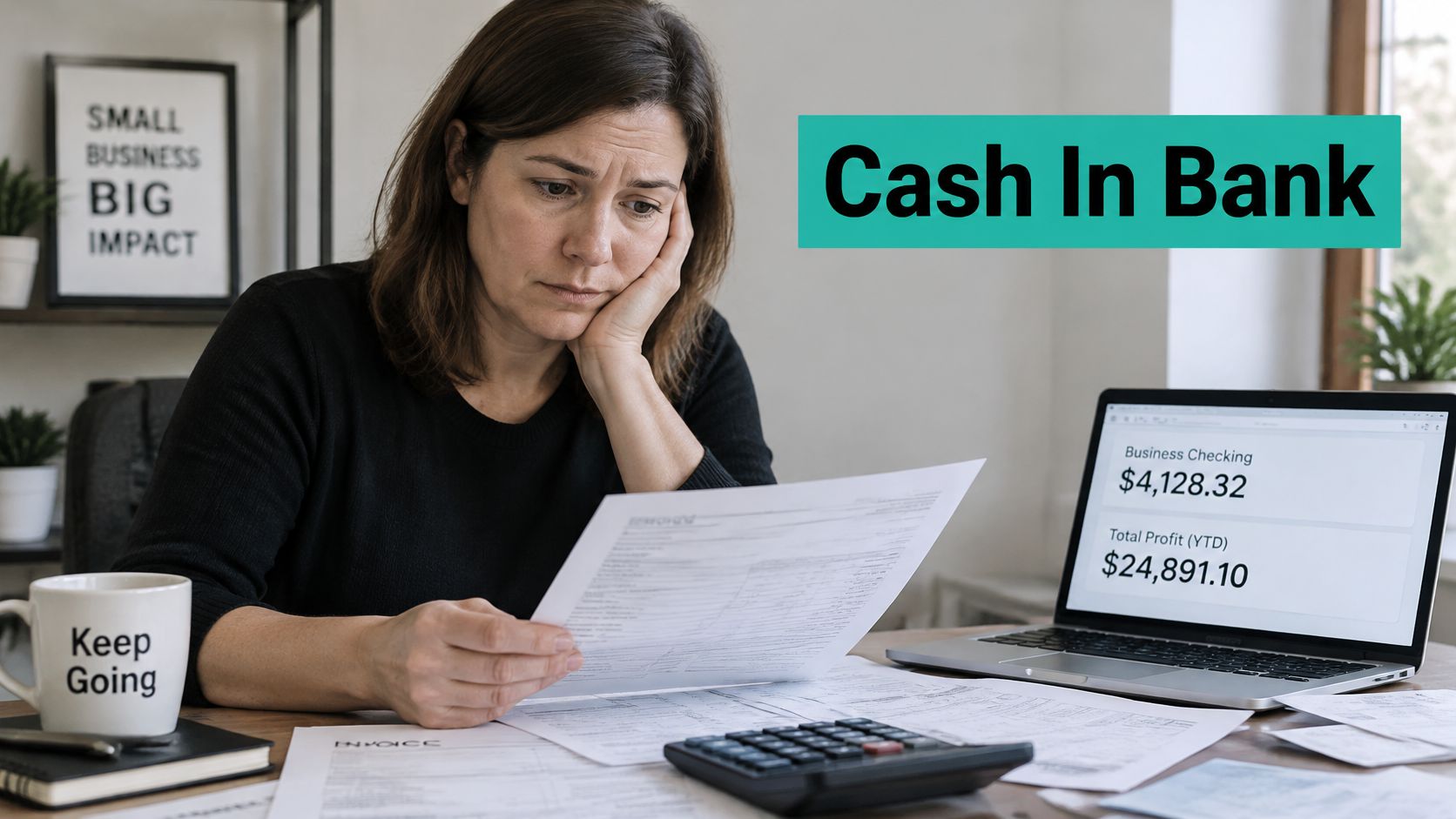
You've sent the invoices, work is booked, and your accounts show a profit. Then you check the bank balance before payroll and realise the money you've earned hasn't arrived. You don't need another monthly sales target. You need to know which day cash gets tight and what you can change before then.
Why a Profitable Business Can Still Run Out of Cash
Say you're a freelance designer who invoices £6,000 in March, gets paid in May, and still owes rent, payroll and tax in April. Your accounts can show profitable work while your bank account heads towards zero. A cash flow forecast shows whether money will be available on the days those bills fall due, something a profit report alone can't tell you.
Profit is the scoreboard at the end of the season. Cash is the fuel in the tank. A good score won't help you finish the journey if you run out of fuel before the last mile.
The pressure isn't confined to struggling businesses. The Federal Reserve's 2025 Small Business Credit Survey found that 75% of U.S. small employer firms identified rising costs of goods, services or wages as a financial challenge, 56% reported difficulty paying operating expenses, and 51% experienced uneven cash flow, including problems collecting receivables.
Look at dates, not just totals
A profitable contract can create an immediate cash squeeze if you buy materials and pay people before the customer pays you. Growing sales can make that squeeze worse when every new job requires spending upfront.
A forecast puts expected receipts and payments on a calendar. Instead of asking whether the month looks profitable, you ask whether Tuesday's supplier payment will clear before Friday's customer receipt.
That's why cash flow forecasting is important: it gives you a deadline for a decision, not just a picture of financial performance. You can chase payment, request a deposit, move an optional purchase or negotiate supplier terms while there's still time.
A healthy set of accounts doesn't remove the need to check payment timing.
Start here: List every bill, payday and expected customer payment for the next 90 days, with its date. Include the obligations you'd rather not think about, especially tax and debt repayments.
Don't wait until your records are perfect. A dated list with clearly marked uncertainties is more useful than a polished profit figure that leaves you guessing about the next bill.
What a Forecast Shows You and What to Do With It
Read a forecast as a decision sheet, not a prediction to admire. Each output should prompt a specific check or action.
Forecast outputs and the decision each one triggers
| Forecast output | What it tells you | Decision it triggers |
|---|---|---|
| Opening balance | Cash in every account on day one | Confirm the starting figure before trusting later days |
| Lowest projected balance | The smallest cash figure in the period | Set a minimum cash floor and act before it is reached |
| Date of lowest balance | When the cash squeeze arrives | Chase invoices or delay spending before that date |
| Runway | Days until cash runs out at current spending | Cut discretionary spending or arrange finance if runway is short |
| Burn rate | Average daily spending compared with the previous period | Slow spending if it is rising faster than income |
| What-if scenario | Balance if a payment is late or income falls | Decide whether to request deposits or change payment terms |
Start with the opening balance. Check every business account, but distinguish accessible operating cash from money reserved for tax or otherwise unavailable. Don't count an overdraft facility as money you already own.
Next, find the lowest projected balance and its date. The closing balance at the end of the forecast can look comfortable even when you can't cover a payment midway through it.
Turn the low point into an action
Consider a hypothetical 90-day forecast with a low point of £1,200 on day 41, against an owner's chosen £1,500 cash floor. The owner follows up two invoices and defers an equipment purchase. Once confirmed collection dates and the postponed purchase are entered, the revised low point sits above the floor.
The useful result isn't the prettier graph. It's the decision to collect money and postpone spending before the squeeze.
Then check runway and burn rate together. Burn rate tracks average daily spending; runway must also account for incoming money. Dividing cash by gross spending can mislead you when receipts continue arriving.
Finally, use the what-if test to challenge your most fragile assumption. The Business Development Bank of Canada's cash-flow management guide identifies forecasting as a way to anticipate cash crunches, improve working-capital decisions and determine when external funding is needed.
Write down your own lowest balance and its date. That date tells you when your chosen response must have taken effect, not when you should start thinking about it.
How to Build a Forecast That Catches Shortfalls
Choose a horizon of 30, 60 or 90 days. Use the shorter view for immediate bills and payroll, and the longer view to catch quarterly tax obligations or seasonal dips that fall within it. Don't rely on monthly totals when receipts and payments land on different days.
Enter opening cash from every account. Start with actual balances and identify which savings are available for operations, so an omitted account doesn't make the forecast look unnecessarily bleak. Keep restricted or earmarked cash separate, and don't mistake available credit for cash.
List outflows by the date money leaves. Include payroll, rent, tax, suppliers, loan repayments, subscriptions and planned purchases, then mark which payments are essential and which are discretionary. A common slip is putting every expense at the start of the month when a direct debit leaves on the 15th.
List inflows by expected payment date. Use customer payment history, confirmed payment promises and settlement timing to estimate when money becomes usable. Sending an invoice isn't receiving cash, and an unconfirmed project shouldn't carry the same weight as a signed retainer.
Calculate the daily closing balance. Use opening cash + inflows − outflows = closing cash, then carry that closing figure into the next day. When combining accounts, exclude transfers between your own accounts from business income and spending so you don't count the same money twice.
Mark the minimum balance and set a cash floor. You might choose one month of fixed costs as a starting reserve, then adjust it for your obligations and income volatility. Don't use zero as your only warning, because you need room to respond before a payment fails.
Update weekly and compare with the bank. Replace estimates with actual transactions, investigate differences and extend the forecast as time passes. Don't merely overwrite a mismatch: identify whether it came from a late receipt, an omitted bill or an unrealistic spending assumption.
Make the assumptions visible
Add a notes column beside uncertain payments. Record whether a receipt is confirmed, expected from previous behaviour or dependent on work that hasn't been agreed.
That small distinction prevents optimism from slipping into the calculation unnoticed. If the plan only works when every prospective customer buys and every existing customer pays promptly, you haven't built a dependable operating forecast.
Use this visual checklist while assembling the underlying records.
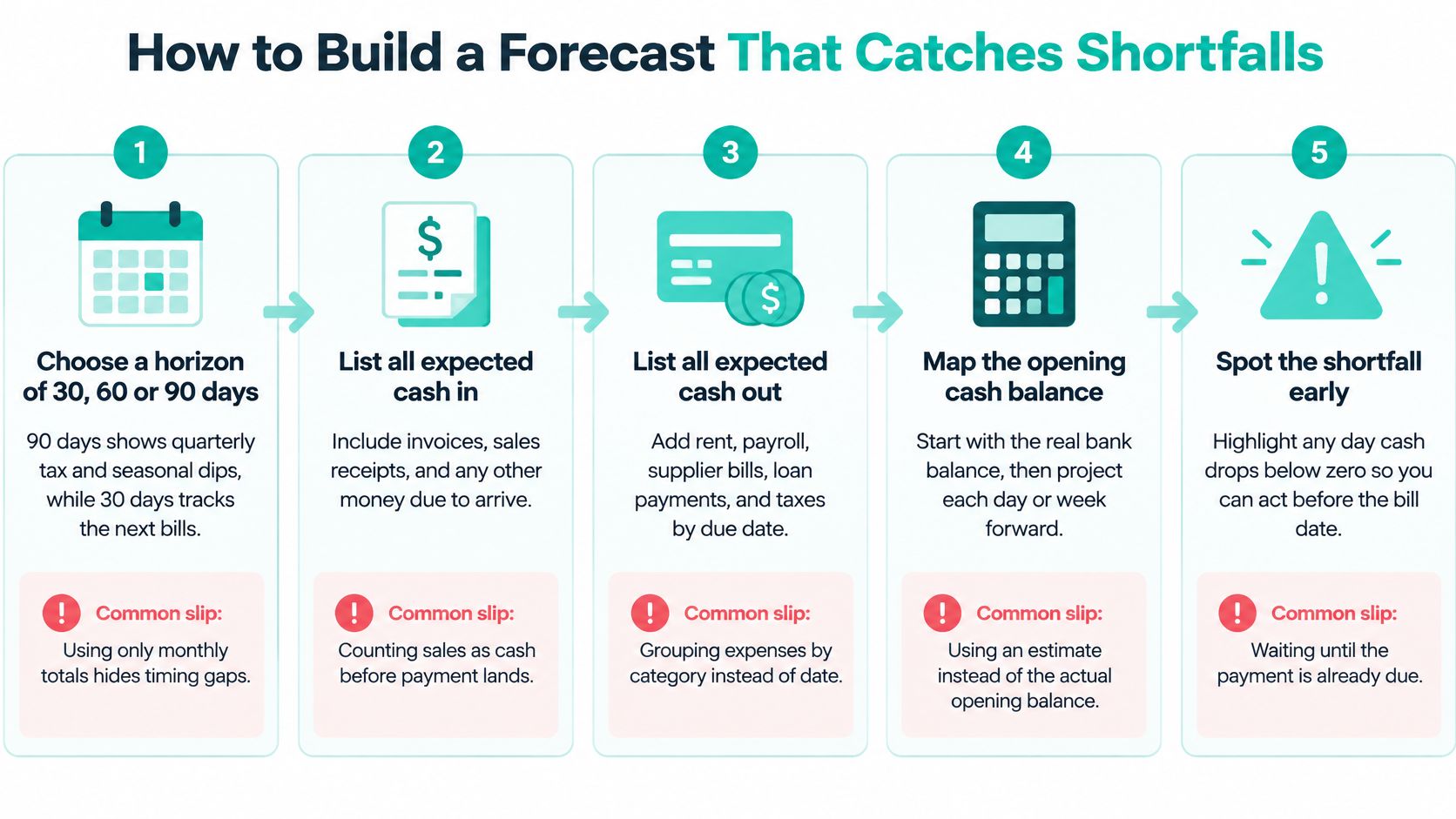
A useful forecast is explainable: You should be able to point to the receipt or payment responsible for a sharp change in the balance.
A spreadsheet works if you maintain it carefully. With a bank-feed-based workflow, use imported transactions to establish the starting position and recurring patterns, then spend your attention checking future dates and missing obligations rather than retyping history.
Late Payments and Irregular Income Change the Forecast
Only 52% of surveyed businesses said customers paid in line with contractual terms, while 36% said customers took longer and 12% said they paid more quickly, according to UK government payment-practices research. Treat the contractual due date as a starting point, not a guarantee.
Late payment rates by sector
| Sector | Mean share of payments received late | What it means for the forecast |
|---|---|---|
| Goods | 21% | Highest late-payment share shown; add a delay buffer to receipts |
| Pharmaceuticals | 19% | Model about a fifth of payments as late, not a fifth longer to arrive |
| Construction | 18% | Give milestone payments a delayed-date version |
| Services | 16% | Even this lower share can move a low-cash date |
| All businesses with business customers | 17% | Use the overall mean only when your own history is missing |
For a hypothetical business issuing ten £2,000 invoices, applying the overall late-payment share would place approximately £3,400 of expected receipts at risk of arriving later than planned. That's an illustration, not a prediction: a share of payments isn't automatically the same share of invoice value, and the rate doesn't tell you how long customers delay.
Give each uncertain invoice an expected date, a probable collection date based on history, and a delayed date for testing. Understanding what counts as cash receipts helps keep money received separate from revenue merely invoiced.
Give uncertain income its own treatment
In a January 2025 QuickBooks survey of 2,487 U.S. small businesses, 56% had outstanding invoices, and businesses with heavier overdue-invoice volumes were 1.4 times more likely to report cash-flow problems. The same survey found problems among 60% of businesses using longer payment terms, compared with 40% using immediate terms.
Model longer terms as a bigger timing gap, not just a customer-service choice. For freelancers and tradies, separate committed retainers from speculative projects, then build best-month, typical-month and weak-month versions.
A freelance-income guide reporting Federal Reserve 2025 household findings notes month-to-month income variation among 58% of self-employed adults versus 28% of employees; 22% versus 10%, respectively, said variation contributed to difficulty paying bills. Separately, the Federal Reserve Banks' employer-firm survey reports that 51% of U.S. employer firms cited uneven cash flows in 2024.
Forecast with the collection behaviour your own records show, not the payment behaviour your contract asks for.
Stress-Test Scenarios and Warning Thresholds
One forecast is one story about what might happen. You need alternatives that expose which change would make the plan fail, without combining every imaginable problem into an unusable disaster scenario.
Scenarios to run before every low-cash date
| Scenario | Assumption to change | What to check |
|---|---|---|
| Base case | Invoices paid on expected dates | Lowest balance stays above your floor |
| Delayed collection | Largest invoice paid 30 days late | Whether payroll and rent still clear on time |
| Low revenue | Monthly income cut by a chosen percentage | Runway in days at current spending |
| Tax-heavy month | Tax payment falls in a weak income month | Cash headroom after the tax payment |
| Lost client | Largest client stops paying | Months of fixed costs covered by reserves |
Start with the base case and require it to clear your cash floor. Next, shift the largest receipt in the delayed-collection test and check payment dates individually, rather than accepting a positive month-end balance.
For low revenue, choose a reduction grounded in your own sales volatility. In the tax-heavy case, protect the money needed for the obligation rather than assuming future sales will replenish it. The lost-client test answers a different question: how much time would reserves buy you to replace that income?
Set the warning before you need it
Financial-distress research examining Istanbul-listed firms supports looking at cash-flow measures alongside conventional performance indicators. Use these checks with thresholds chosen for your business:
- Operating cash flow divided by total debt: Track whether cash generation is weakening relative to borrowing, using a consistent forecast period.
- Projected cash divided by current liabilities: Check how much near-term exposure your available cash covers.
- Headroom after mandatory payments: Require enough remaining cash to preserve your chosen reserve, such as one month of fixed costs.
These aren't interchangeable ratios or universal pass marks. Healthy sales can coexist with weak coverage when customers pay slowly or debt repayments cluster, while a temporary sales dip may be manageable when reserves hold.
Don't assume borrowing will rescue a failed test. Entrepreneur, reporting Federal Reserve survey findings, states that 29% of U.S. small businesses reported difficulty accessing credit in 2024.
If a scenario breaches your threshold, choose an action now and enter its realistic effect into the forecast.
Confirm Your Forecast Before the Next Bill Date
Make this week's review practical: confirm the accounts, identify the low point and commit to a response.
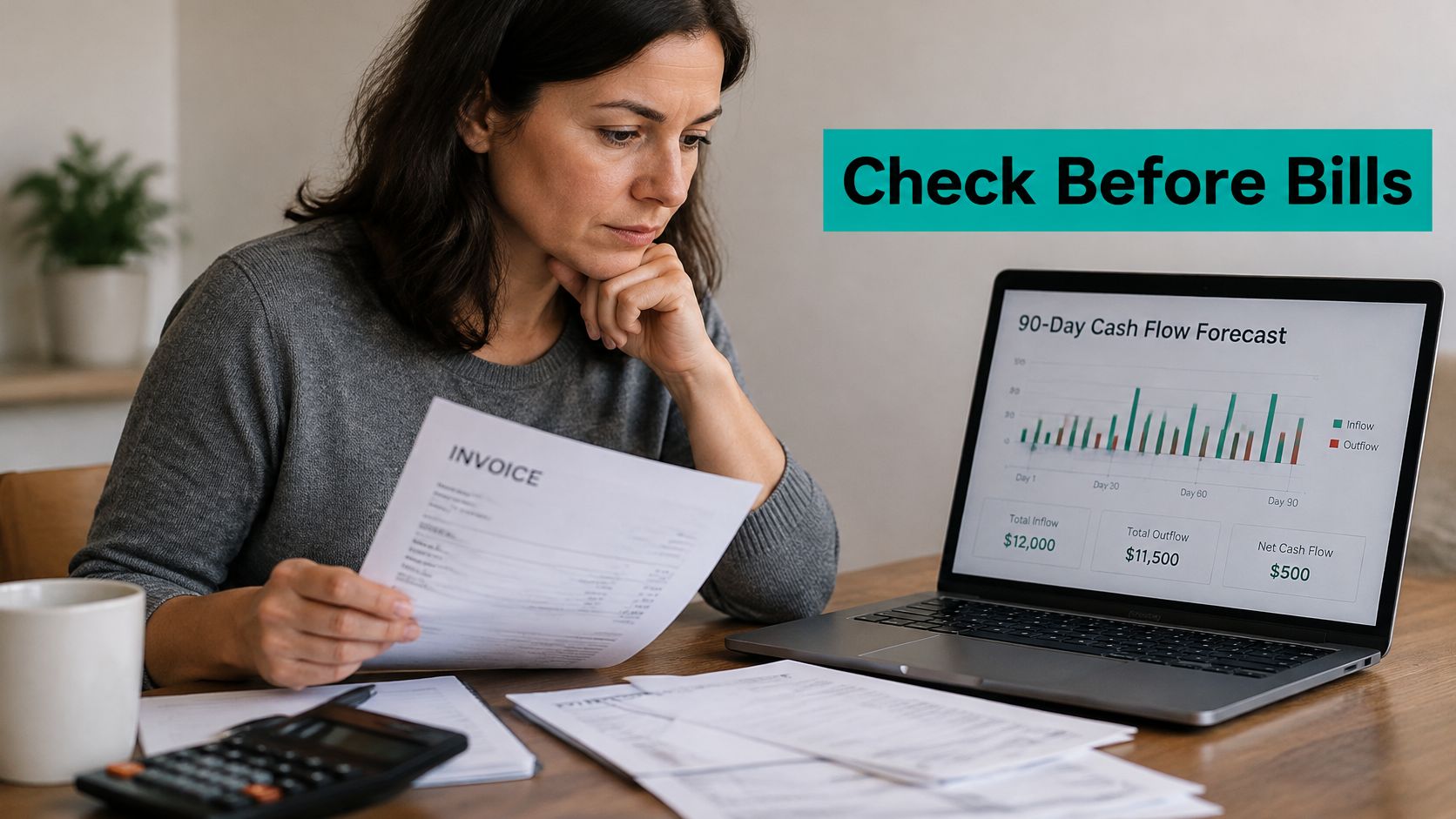
Open your 90-day view and reconcile opening cash across every account, including savings. Write down the lowest balance, its date and your cash floor, then choose one response that takes effect beforehand: an invoice reminder, a paused purchase or an early credit application.
At our AI2Fin tools page, explore options for building and comparing your forecast. Our Cash Flow Forecast shows the next 90 days, the lowest point, runway and a what-if test; 30-, 60- and 90-day forecasts are included on ELITE+ and AUTO+, not Free or Premium. Fin also recognises recurring bills, calculates the next instalment date and shows upcoming or overdue bills beside their charge history.
Keep a weekly appointment to compare the forecast with your bank balance and fix the assumption behind any gap. If the low point approaches your floor, act sooner.
Use the video alongside your review.
AI2Fin brings upcoming bills, paydays and money you're owed into a practical view of what's ahead. Visit AI2Fin to turn those dates into a cash forecast, test a late-payment scenario and choose your next action before cash gets tight.